For parents, driver’s education can feel like a major milestone. It marks progress, creates structure, and helps a teen move closer to independent driving. But passing driver’s ed is not the same as being ready to drive on your own. That distinction matters because formal instruction is only part of what makes a young driver safer. A teen may complete the required hours, understand the rules of the road, and still need more experience before handling everyday traffic without supervision. For many families, the real question is not whether the course was completed. It is whether the teen is prepared to make good decisions when the road becomes unpredictable.
Why Completion and Readiness Are Not the Same Thing
Driver’s education provides a foundation. It introduces road rules, basic vehicle control, and structured practice under supervision. That foundation matters, but it is still only a beginning. Readiness develops when those lessons are repeated in different conditions and under the kinds of pressure that come with ordinary driving. A teen may perform well in a lesson and still struggle when faced with heavy traffic, a rushed left turn, a distracted passenger, or an unfamiliar route. Those are not signs that instruction failed. They are signs that experience still matters.
This is where many parents begin to think differently about what readiness really means. A certificate or course completion record shows that a teen met an important requirement. It does not automatically indicate that the teen can handle all the everyday challenges that come with driving independently. That is why so many families discover that the most important learning often happens after formal instruction has already begun or even after it has been completed.

Why Parents Are Right to Look Beyond Minimum Requirements
Parents are often told what the legal requirements are, but their concerns usually go beyond the checklist. They want to know whether their teen can stay calm under pressure, scan consistently, judge speed and distance well, and handle changing traffic conditions without becoming overwhelmed. These are practical questions, and they do not always have simple yes-or-no answers. In many cases, parents are seeing progress in real time and trying to decide whether it is enough for the next step.
A recent Baton Rouge-focused article, Why Teen Driver Readiness Is Becoming a Bigger Parent Concern in Baton Rouge, made this point clearly by showing how local families are thinking beyond licensing milestones and focusing more on actual preparedness. That local framing matters because it reflects what many parents already feel. A teen can be on track officially while still needing more time to become truly ready for independent driving.
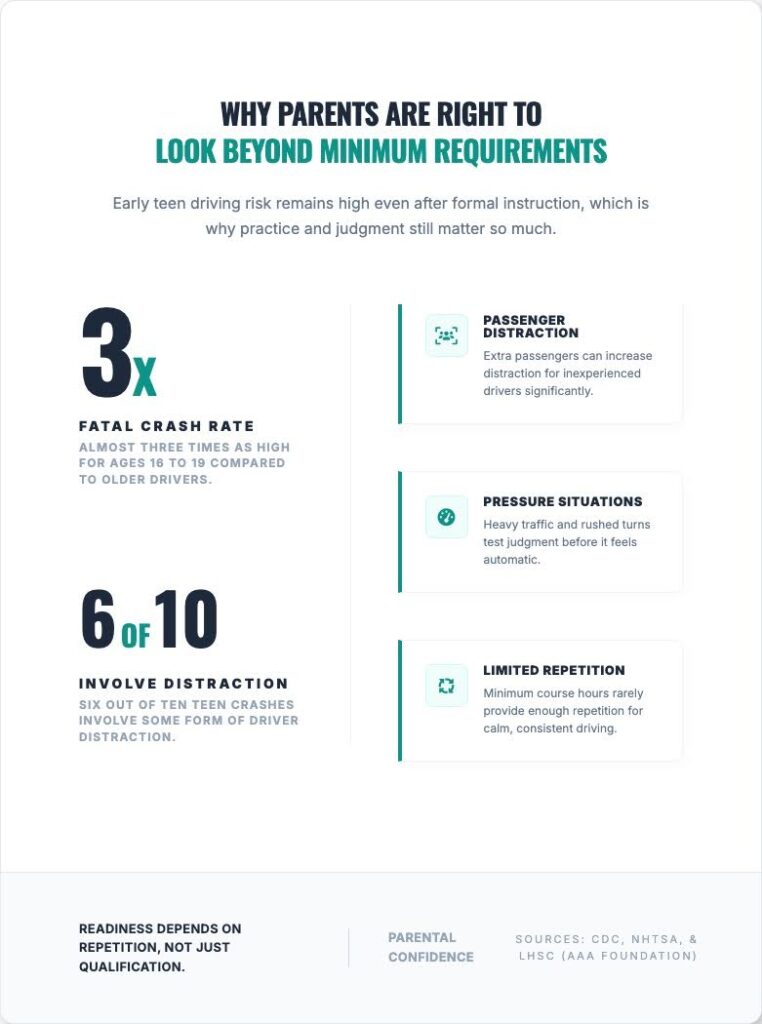
Practice Builds the Judgment That Courses Alone Cannot Fully Create
One reason passing driver’s ed is not enough on its own is that judgment improves through repetition. A teen has to experience the flow of real roads enough times for good habits to become more natural. That includes scanning intersections, handling lane changes smoothly, anticipating what other drivers may do, and staying composed when something unexpected happens. These are not only technical skills. They are layered habits that improve with exposure and reflection.
Parents often notice this development gradually. The teen starts braking more smoothly. Turns become less hesitant. Mirror checks happen with less prompting. Busy intersections begin to feel more manageable. These improvements rarely arrive all at once, which is why readiness is often a matter of consistency rather than a single breakthrough. The teen may understand what to do long before they can do it calmly and reliably across a variety of situations.
Confidence and Overconfidence Are Not the Same
Another reason this distinction matters is that teens can sometimes appear more ready than they are. Early success can create confidence, and confidence is useful. But confidence without enough repetition can become overconfidence, especially when a teen starts assuming that understanding the basics means they are prepared for every common driving scenario. Parents often sense this tension. They want their teen to feel capable, but they also do not want capability to be mistaken for full readiness.
This is why supervised practice remains so important even after formal instruction is underway or completed. It allows teens to build confidence while still having an adult present to correct minor errors, point out missed hazards, and gradually introduce more difficult conditions. That kind of progression helps confidence become steadier and more grounded in real experience rather than in a single successful lesson or test result.
Parents Play a Bigger Role Than Many Realize
Even with a strong driver’s education program, parents remain central to the readiness process. They are often the ones choosing when to expand practice, when to introduce more challenging roads, and when to keep restrictions in place a little longer. That role can feel uncertain because parents are balancing encouragement with caution. Still, their involvement often makes the difference between a teen who merely completed the course and a teen who is actually becoming more dependable behind the wheel.
That is one reason parent-guided practice should not be viewed as a secondary add-on. It is part of what turns instruction into readiness. Teens benefit from repeated exposure to the exact kinds of conditions they will face most often, including local traffic patterns, rain, school routes, nighttime driving, and distractions that arise during normal daily movement. The more intentional the practice, the more clearly parents can evaluate whether progress is truly holding.
What Jeremy Watson Says Families Should Pay Attention To
Jeremy Watson, owner and lead instructor at Magnolia Driving Academy, says parents often benefit from watching for steadiness rather than just completion. In his view, readiness shows up in how a teen repeatedly handles common road situations, not only in whether they can perform a skill once under instruction. He points to scanning habits, calm decision-making, awareness of surrounding traffic, and the ability to recover without panic when something unexpected happens as signs that matter in the real world.
That perspective makes sense because driving alone requires more than remembering the rules. It requires applying them while managing pressure, distractions, and changing conditions. Parents often see those differences more clearly than they expect. A teen might seem capable on familiar neighborhood streets but still need more support in busier corridors or at night. Readiness is therefore less about whether the teen finished learning and more about whether their performance is becoming more dependable across situations.
Structured Instruction Still Provides an Important Starting Point
None of this means driver’s education is unimportant. In fact, structured instruction remains one of the best ways to give teens a safer beginning. A course introduces consistent teaching, supervised behind-the-wheel practice, and a more organized entry point into driving. For parents who want that kind of structure, a program like this teen driver education course for Baton Rouge families offers guided training that can help teens start with a stronger foundation.
The more useful way to think about driver’s education is as the first step in a larger process. It helps families move from uncertainty to structure, but it does not eliminate the need for continued practice and careful parental judgment. A completed course gives the teen a base. Real readiness is built by what happens next.
Why Parents Need to Watch for Real-World Consistency
The strongest sign of readiness is not whether a teen can perform well once. It is whether they can perform well consistently. Parents should look for steady behavior across different environments, not only in the most comfortable ones. That includes traffic, parking lots, unfamiliar roads, poor weather, and moments when other drivers behave unpredictably. If performance changes sharply depending on the setting, the teen may still be building toward readiness rather than having fully reached it.
This is one reason the period after driver’s ed often feels so important. Families can see the difference between a teen who understands driving in theory and one who is beginning to handle it more maturely and consistently. That difference is what makes the conversation about readiness feel so personal and so necessary.
Conclusion
Passing driver’s ed is a meaningful milestone, but it is not the same as being ready to drive on your own. Completion shows that a teen has received instruction and met a requirement. Readiness shows that the teen can apply those lessons with consistency, judgment, and calmness in the situations that real driving brings. For parents, that is the difference that matters most. The safest path is not to treat the course as the finish line, but as the beginning of the experience that turns learning into real independence.