Nobody wants to be the first real patient a new nurse, paramedic or doctor has ever treated. For a long time, though, much of clinical learning happened on real patients, under supervision. Medicine even had a saying for it: see one, do one, teach one.
Simulation adds another option. Some of a clinician’s early practice can now happen on patients who can’t be harmed, because they aren’t real.
What does “simulation” mean in health care training?
It covers a few different things, and they do different jobs.
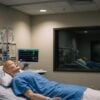
Manikins. Life-size models in a simulation lab. The more advanced ones can simulate breathing, bleeding or a heart attack on cue, while an instructor watches from behind glass and changes what happens next.
Standardized patients. Trained actors who play a patient with a specific problem, so students can practice taking a history, examining someone and breaking bad news to a real human face.
Virtual patients. Interactive cases on a computer screen. The learner asks questions, orders tests and makes decisions, and the case responds to those choices. There’s no lab or actor to book, so the same case can be assigned across a whole class.
Scenario practice has a place in paramedic and nursing training as well, letting a student rehearse a difficult call or a patient who is getting worse before they face the real thing.
Does practicing on a screen actually work?
The evidence is encouraging, with some honest caveats.
In 2019, a team led by Andrzej Kononowicz published a large review in the Journal of Medical Internet Research. They pooled 51 trials with 4,696 participants across the health professions. Compared with traditional teaching, virtual patients improved skills more, and students learned about as much factual knowledge either way. Clinical reasoning was among the skills that improved.
The researchers rated the certainty of that evidence as low to modest. In plain terms, the results point in a good direction, but more and better studies are needed before anyone calls it settled.
What a virtual patient case looks like
Picture a student at a laptop. On screen, a 58-year-old man arrives with shortness of breath that has been getting worse for a week.
The student chooses what to ask. Any chest pain? Swollen ankles? Recent travel? Each question reveals a little more. They choose what to examine and which tests to order. Partway through, the case pauses and asks them to say what they think is going on.
Afterward, a debrief can go through which results actually changed the picture and which didn’t. That kind of unhurried discussion is harder to fit in at a busy bedside.
Why it matters to you as a patient
One of simulation’s most useful jobs is practice on the rare and the frightening.
A student might go months on placement without seeing a severe allergic reaction or a patient in septic shock. In a simulation, they can meet that patient on a Tuesday afternoon, get it wrong, talk through what happened and try again. That isn’t the same as managing the real thing, but it means the real thing isn’t their first look at it.
It also changes what feedback can look like. On a busy ward, there isn’t always time to explain why a decision was wrong. A simulated case can be stopped, reviewed and talked through afterward.
Teaching the thinking, not just the doing
Some tools focus less on hands-on skills and more on how a clinician thinks.
Diagnosis is as much a thinking job as a hands-on one. A familiar trap is latching onto the first explanation that fits and then no longer looking for others. So some virtual patient simulation tools stop the learner partway through a case and ask them to commit: what do you think is going on, and what else could it be? Only then does the case move on. At the end, the learner can compare their reasoning with how an experienced clinician approached the same patient.
It sounds simple. It’s a habit, though, and habits take repetition.
What simulation can’t do
A screen can’t hold a frightened patient’s hand. A manikin doesn’t flinch, and an actor who plays the same patient every week is not the same as a stranger in pain at 4 a.m.
Simulation works best as preparation for real patients, not a replacement for them. The goal is that when a student does meet you, they’ve already practiced the hard parts somewhere safe.
The next time a student introduces themselves
If a nursing or medical student asks to be involved in your care, they may well have worked through practice patients before reaching you. Some of those patients breathed on a table. Some lived on a screen. All of them were there to help that student arrive better prepared.