Selling to the Department of Defense has a reputation among startups: slow, bureaucratic and hard to scale. Oluseun Taiwo, founder and CEO of Solideon, sees it differently.
“Defense actually helps build a stable commercial market.”
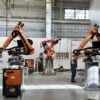
Solideon builds deployable factories from standard industrial robot arms and its own software. The systems print, machine, assemble and inspect large metal parts, and they could serve almost any heavy industry. The company chose to lead with defense anyway.
Why defense comes first
Military customers have the most urgent version of the problem Solideon solves. Bases and ships operate far from suppliers, supply lines can be cut, and a missing part can ground an aircraft or keep a vessel in port. The value of making a part on site is obvious and easy to measure.
Defense programs also bring funding that pays for development. Solideon’s $1.25 million AFWERX contract with the U.S. Air Force funds a single-pallet manufacturing cell for expeditionary sites. Its Norfolk, Virginia, operation, Solideon Defense, produces submarine hull sections and large defense hardware with shipbuilder Fairlead.
Finally, defense is a demanding reference. A system that works for the Navy and the Air Force has a strong case with commercial buyers who worry about reliability.
Where commercial demand sits
The commercial opportunities share the same profile: remote locations, expensive downtime and long supply chains. Taiwo has pointed to offshore oil rigs, where shipping a replacement part can cost more in lost time than the part itself. Solideon’s markets also include energy, automotive and aerospace.
Its claims are pitched at operators. The company says its process needs no traditional tooling, which it puts at four months or more, removes more than 90% of human intervention, and can cut weight by up to 20%.
The risk in the strategy
Leading with defense has trade-offs. Contracts can be slow to convert into production orders, and a small team has to manage long sales cycles. Solideon has raised roughly $9 million to date, according to Taiwo, and expects more funding as it grows.
But the decision follows a clear line of reasoning. Use the customer with the sharpest need to fund and prove the technology, then carry that proof into markets where the same problem shows up with a different badge on the door.
For a company that moved its headquarters to Los Angeles in 2026 and is still scaling up part sizes, it is a decision built for durability more than speed.