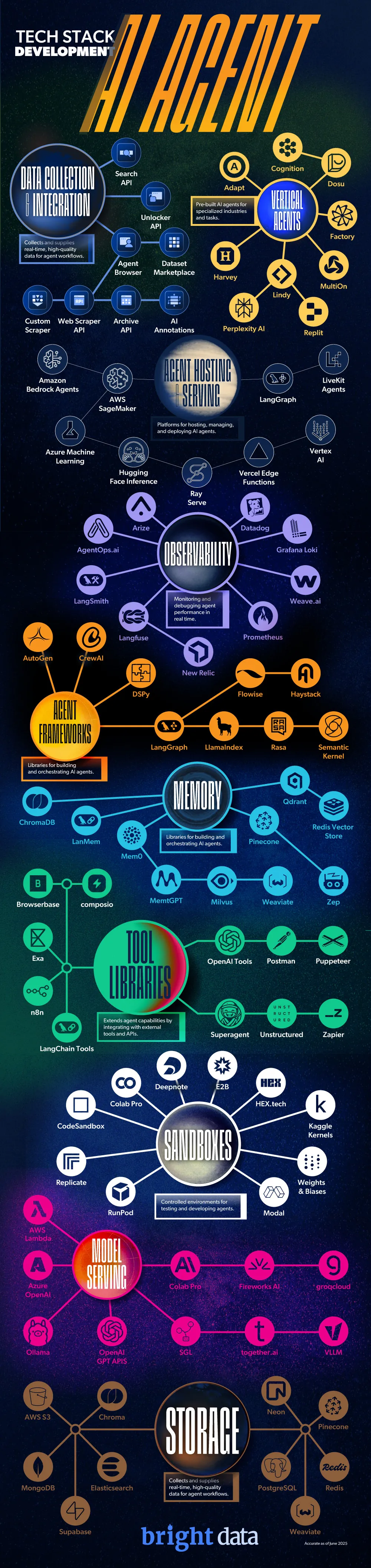
Understanding an AI agent’s tech stack is critical for developers. It’s not enough to know which tools are trending – a developer must be intimately aware of how the tools work together, where the real value lies, and which foundational layers must be in place for the agents to perform with precision. The answer is actually quite clear: the data an AI agent is trained on is the core layer for its operations. After all, an agent’s ability to reason, plan, or act is all based on the information it has access to. Without reliable access to the public web’s current information, even the most advanced agents will fail to produce relevant outputs.
There are many other layers that comprise a tech stack, though. Agenting hosting services provide the digital environment that turns a static model into a dynamic, autonomous system. Observability tools allow developers to monitor performance and debug issues in real time to ensure the agents continue to run smoothly. Memory tools help the agents to retain context, so users don’t have to repeatedly feed the agent the same information each time they use it. These tools all weave together to create a powerful machine that can serve as an employee’s personal assistant or even thought partner.
Source: Bright Data